<?xml version="1.0" encoding="utf-8"?><feed xmlns="http://www.w3.org/2005/Atom" ><generator uri="https://jekyllrb.com/" version="4.3.4">Jekyll</generator><link href="http://localhost:4000/lab/feed.xml" rel="self" type="application/atom+xml" /><link href="http://localhost:4000/lab/" rel="alternate" type="text/html" /><updated>2026-06-11T10:57:56-04:00</updated><id>http://localhost:4000/lab/feed.xml</id><title type="html">prosodylab</title><subtitle>a research lab at mcgill</subtitle><author><name>MW</name></author><entry><title type="html">Resolving symmetry without constraining alternatives</title><link href="http://localhost:4000/lab/news/2026/06/11/resolving-symmetry.html" rel="alternate" type="text/html" title="Resolving symmetry without constraining alternatives" /><published>2026-06-11T00:00:00-04:00</published><updated>2026-06-11T00:00:00-04:00</updated><id>http://localhost:4000/lab/news/2026/06/11/resolving-symmetry</id><content type="html" xml:base="http://localhost:4000/lab/news/2026/06/11/resolving-symmetry.html"><![CDATA[<p><em>Early access publication available now:</em></p>

<p><strong>Schwarz, Bernhard and Michael Wagner(2026). Resolving symmetry without constraining alternatives.</strong> Semantics &amp; Pragmatics, 8:EA.  DOI: <a href="https://doi.org/10.3765/sp.19.8">10.3765/sp.19.8</a></p>

<p>Abstract:</p>

<p>In cases where an assertion could in principle lead to several, mutually incompatible quantity implicatures, some of these implicatures seem systematically unavailable. Katzir (2007) and Fox &amp; Katzir (2011) aim to solve this so-called ‘symmetry problem’ by preventing implicatures that are based on the exclusion of alternatives that are syntactically more complex than the assertion itself. We argue that this complexity filter on alternatives falls short of solving the symmetry problem completely, and is in fact incompatible with the full range of observed implicatures. We propose a solution to the symmetry problem that, in addition to context, appeals to a blocking condition: enriching the meaning of an utterance φ with an implicature is blocked if the same meaning can be expressed without this implicature, by an utterance that is no more complex than φ. In making our case, we also argue against a central auxiliary assumption that Katzir and Fox’s account appeals to, namely the assumption that symmetry cannot be resolved by context.</p>]]></content><author><name>MW</name></author><category term="news" /><category term="paper" /><summary type="html"><![CDATA[Early access publication available now: Schwarz, Bernhard and Michael Wagner(2026). Resolving symmetry without constraining alternatives. Semantics &amp; Pragmatics, 8:EA. DOI: 10.3765/sp.19.8 Abstract: In cases where an assertion could in principle lead to several, mutually incompatible quantity implicatures, some of these implicatures seem systematically unavailable. Katzir (2007) and Fox &amp; Katzir (2011) aim to solve this so-called ‘symmetry problem’ by preventing implicatures that are based on the exclusion of alternatives that are syntactically more complex than the assertion itself. We argue that this complexity filter on alternatives falls short of solving the symmetry problem completely, and is in fact incompatible with the full range of observed implicatures. We propose a solution to the symmetry problem that, in addition to context, appeals to a blocking condition: enriching the meaning of an utterance φ with an implicature is blocked if the same meaning can be expressed without this implicature, by an utterance that is no more complex than φ. In making our case, we also argue against a central auxiliary assumption that Katzir and Fox’s account appeals to, namely the assumption that symmetry cannot be resolved by context.]]></summary></entry><entry><title type="html">Adjunctive Coordination</title><link href="http://localhost:4000/lab/news/2026/06/10/elm.html" rel="alternate" type="text/html" title="Adjunctive Coordination" /><published>2026-06-10T00:00:00-04:00</published><updated>2026-06-10T00:00:00-04:00</updated><id>http://localhost:4000/lab/news/2026/06/10/elm</id><content type="html" xml:base="http://localhost:4000/lab/news/2026/06/10/elm.html"><![CDATA[<p>Online poster presentation at <strong><a href="https://www.elm-conference.net/elm-4-2026/">ELM 4 2026, UPenn</a></strong>:</p>

<p><strong>Wagner, Michael (2016). Adjunctive Coordination: The case of German <em>samt</em>.</strong> Poster presentation at the 4th conference on Experiments in Linguistic Meaning (ELM 4) <a href="http://www.prosodylab.org/~chael/papers/wagner2026elm.pdf">[Slides]</a></p>]]></content><author><name>MW</name></author><category term="news" /><category term="poster" /><summary type="html"><![CDATA[Online poster presentation at ELM 4 2026, UPenn: Wagner, Michael (2016). Adjunctive Coordination: The case of German samt. Poster presentation at the 4th conference on Experiments in Linguistic Meaning (ELM 4) [Slides]]]></summary></entry><entry><title type="html">Adjectival agreement is interpretable</title><link href="http://localhost:4000/lab/news/2026/05/05/wccfl.html" rel="alternate" type="text/html" title="Adjectival agreement is interpretable" /><published>2026-05-05T00:00:00-04:00</published><updated>2026-06-11T00:00:00-04:00</updated><id>http://localhost:4000/lab/news/2026/05/05/wccfl</id><content type="html" xml:base="http://localhost:4000/lab/news/2026/05/05/wccfl.html"><![CDATA[<p>Poster at <strong><a href="https://wccfl44.github.io/WCCFL44/">WCCFL 44 2026, Universidad Nacional Autónoma de México</a></strong>:</p>

<p><strong>Almeida, Anna Carolina  Cox-Casals, Raimundo  and Wagner, Michael (2026). Adjectival agreement is interpretable: Evidence from summative agreement in Mexican Spanish and Brazilian Portuguese.</strong> Poster presentation at the 44th West Coast Conference on Formal Linguistics, Universidad Nacional Autónoma de México. <a href="http://www.prosodylab.org/~chael/papers/CumulativeAgreementWCCFL2026-Poster.pdf">[Poster]</a> <a href="https://osf.io/d3x5s/overview">[OSF]</a></p>]]></content><author><name>MW</name></author><category term="news" /><category term="poster" /><summary type="html"><![CDATA[Poster at WCCFL 44 2026, Universidad Nacional Autónoma de México: Almeida, Anna Carolina Cox-Casals, Raimundo and Wagner, Michael (2026). Adjectival agreement is interpretable: Evidence from summative agreement in Mexican Spanish and Brazilian Portuguese. Poster presentation at the 44th West Coast Conference on Formal Linguistics, Universidad Nacional Autónoma de México. [Poster] [OSF]]]></summary></entry><entry><title type="html">Labphon 2024 in Seoul</title><link href="http://localhost:4000/lab/news/2024/06/27/labphon.html" rel="alternate" type="text/html" title="Labphon 2024 in Seoul" /><published>2024-06-27T00:00:00-04:00</published><updated>2023-02-14T00:00:00-05:00</updated><id>http://localhost:4000/lab/news/2024/06/27/labphon</id><content type="html" xml:base="http://localhost:4000/lab/news/2024/06/27/labphon.html"><![CDATA[<p><strong>Session on Labphon of sentences at Labphon 2024 in Seoul:</strong></p>

<p>Invited Speaker: Fernanda Ferreira (UC Davis, USA). <a href="https://labphon.org/sites/default/files/labphon19/Papers/LabPhon19_invited_2.pdf">Prosody, Syntax, and Conversational Language</a></p>

<p>Buhan Guo, Nino Grillo, Sven Mattys, Andrea Santi, Shayne Sloggett, Giuseppina Turco (U of York; U of York; U of York; U College London; U of York; Laboratoire de Linguistique Formelle, UMR 7110, CNRS/Université Paris Cité) 
<a href="https://labphon.org/sites/default/files/labphon19/Papers/LabPhon19_paper_229.pdf">The Garden Path Leading to Intonational Phonology</a></p>

<p>Nele Ots (Goethe-Universität Frankfurt). <a href="https://labphon.org/sites/default/files/labphon19/Papers/LabPhon19_paper_228.pdf">Cross-linguistic survey of intonation planning: a cognitive approach</a></p>

<p><a href="http://www.prosodylab.org/~chael/papers/wagner_2024_labPhon.pdf">Slides from my discussant presentation</a></p>]]></content><author><name>MW</name></author><category term="news" /><category term="talk" /><summary type="html"><![CDATA[Session on Labphon of sentences at Labphon 2024 in Seoul: Invited Speaker: Fernanda Ferreira (UC Davis, USA). Prosody, Syntax, and Conversational Language Buhan Guo, Nino Grillo, Sven Mattys, Andrea Santi, Shayne Sloggett, Giuseppina Turco (U of York; U of York; U of York; U College London; U of York; Laboratoire de Linguistique Formelle, UMR 7110, CNRS/Université Paris Cité) The Garden Path Leading to Intonational Phonology Nele Ots (Goethe-Universität Frankfurt). Cross-linguistic survey of intonation planning: a cognitive approach Slides from my discussant presentation]]></summary></entry><entry><title type="html">The iambic trochaic law without iambs or trochees</title><link href="http://localhost:4000/lab/news/2023/02/14/trochee-bias.html" rel="alternate" type="text/html" title="The iambic trochaic law without iambs or trochees" /><published>2023-02-14T00:00:00-05:00</published><updated>2023-02-14T00:00:00-05:00</updated><id>http://localhost:4000/lab/news/2023/02/14/trochee-bias</id><content type="html" xml:base="http://localhost:4000/lab/news/2023/02/14/trochee-bias.html"><![CDATA[<p><strong>New paper in JASA:</strong></p>

<p>Moghiseh, E., Sonderegger, M., and Wagner, M. (2023). The iambic-trochaic law without iambs or trochees: Parsing speech for grouping and prominence. Journal of the Acoustical Society of America, 153(2):1108–1129. <a href="https://doi.org/10.1121/10.0017170">[doi]</a> <a href="https://osf.io/bsfvu/">[osf]</a></p>

<center><img src="/lab/assets/images/2023/02/iambictrochaic.png" width="400" class="center" /></center>

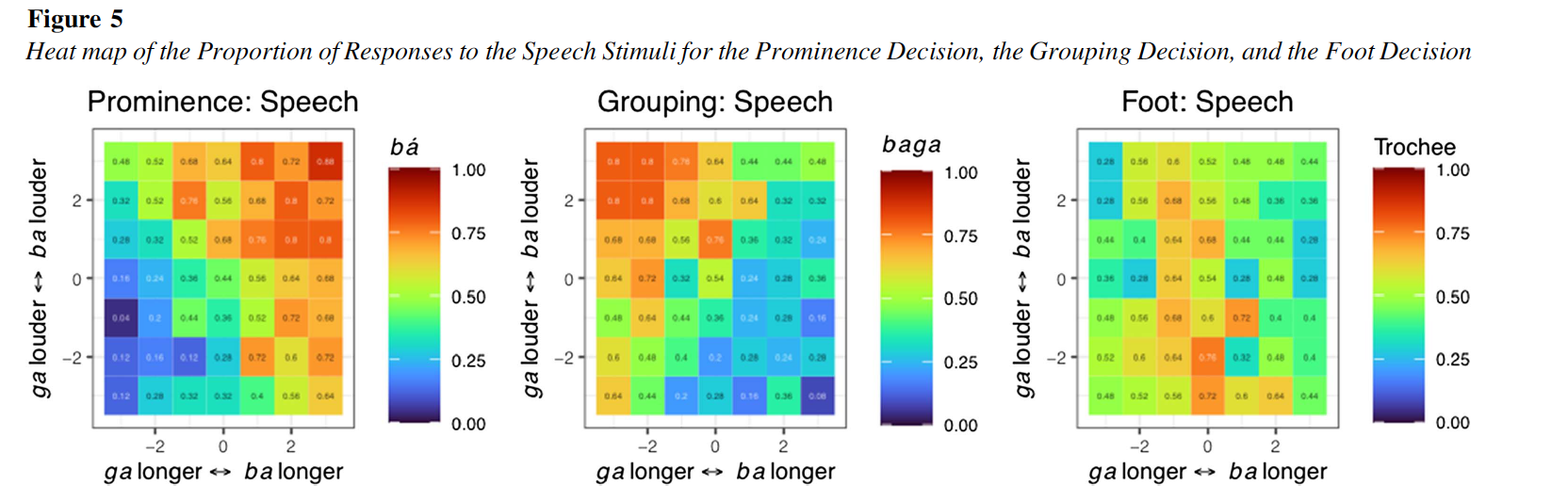
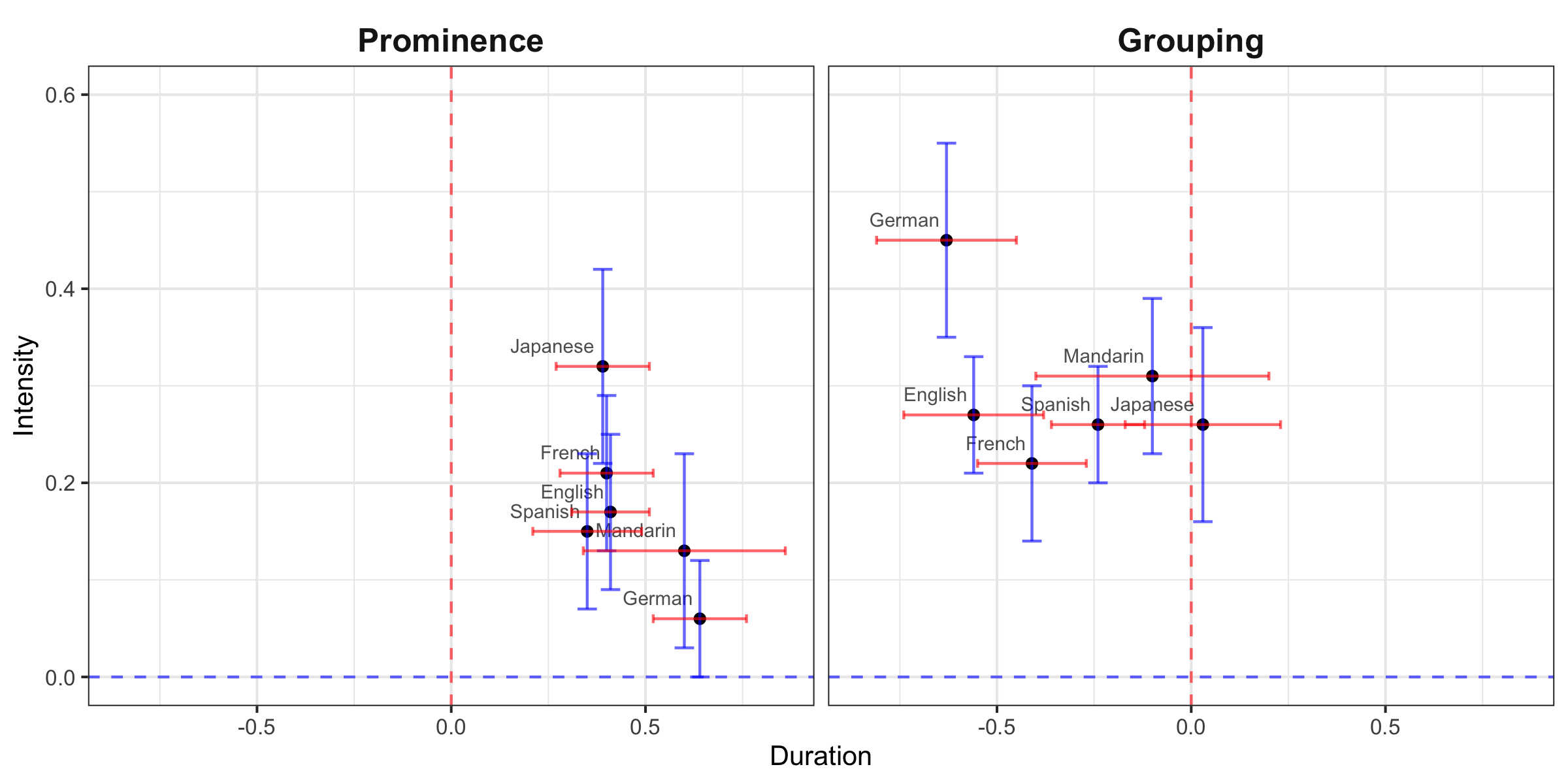
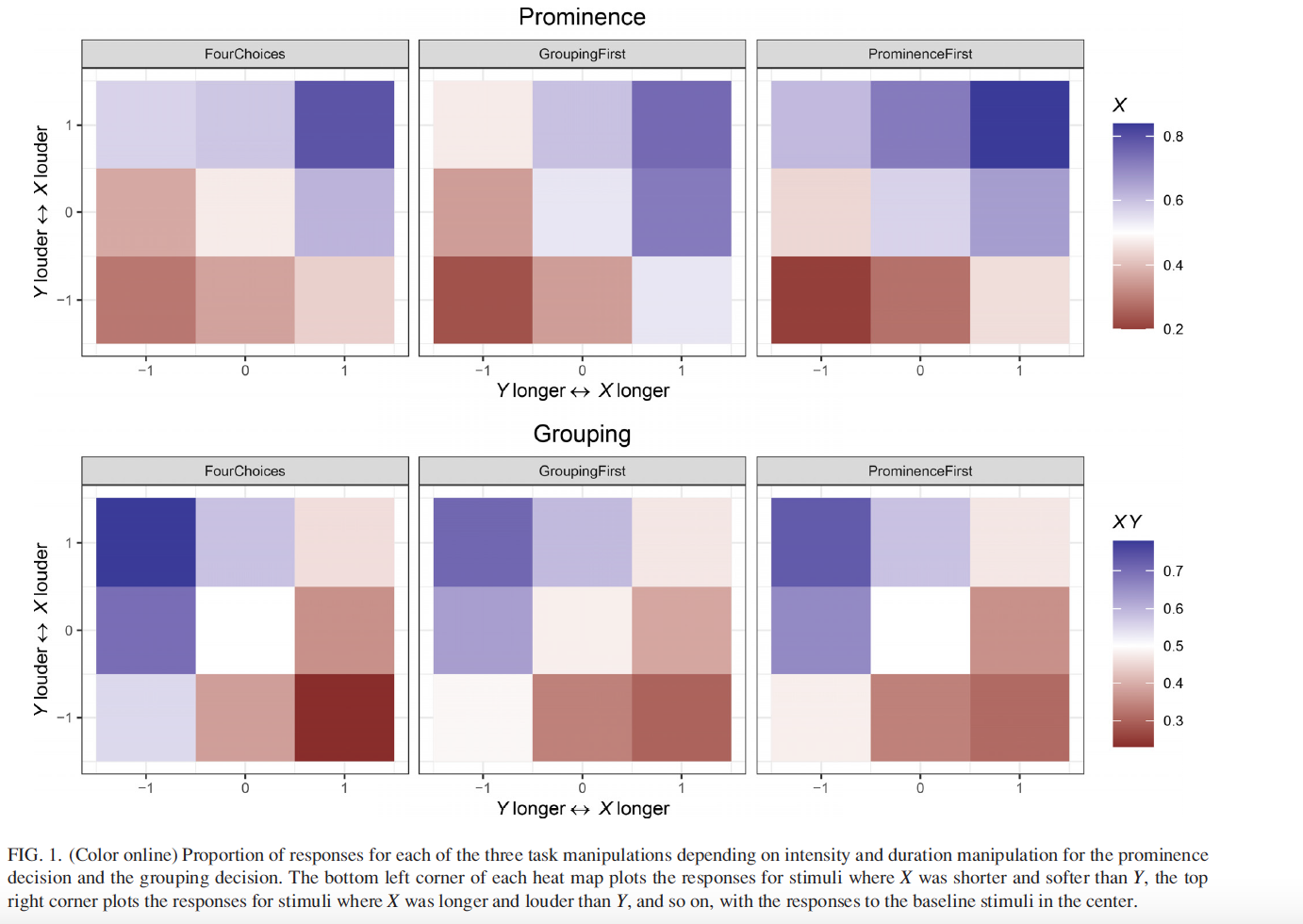
<p><em>Listeners parse the speech signal effortlessly into words and phrases, but many questions remain about how. One classic idea is that rhythm-related auditory principles play a role, in particular, that a psycho-acoustic “iambic-trochaic law” (ITL) ensures that alternating sounds varying in intensity are perceived as recurrent binary groups with initial prominence (trochees), while alternating sounds varying in duration are perceived as binary groups with final prominence (iambs). We test the hypothesis that the ITL is in fact an indirect consequence of the parsing of speech along two in-principle orthogonal dimensions: prominence and grouping. Results from several perception experiments show that the two dimensions, prominence and grouping, are each reliably cued by both intensity and duration, while foot type is not associated with consistent cues. The ITL emerges only when one manipulates either intensity or duration in an extreme way. Overall, the results suggest that foot perception is derivative of the cognitively more basic decisions of grouping and prominence, and the notions of trochee and iamb may not play any direct role in speech parsing. A task manipulation furthermore gives new insight into how these decisions mutually inform each other.</em></p>]]></content><author><name>MW</name></author><category term="news" /><category term="talk" /><summary type="html"><![CDATA[New paper in JASA: Moghiseh, E., Sonderegger, M., and Wagner, M. (2023). The iambic-trochaic law without iambs or trochees: Parsing speech for grouping and prominence. Journal of the Acoustical Society of America, 153(2):1108–1129. [doi] [osf] Listeners parse the speech signal effortlessly into words and phrases, but many questions remain about how. One classic idea is that rhythm-related auditory principles play a role, in particular, that a psycho-acoustic “iambic-trochaic law” (ITL) ensures that alternating sounds varying in intensity are perceived as recurrent binary groups with initial prominence (trochees), while alternating sounds varying in duration are perceived as binary groups with final prominence (iambs). We test the hypothesis that the ITL is in fact an indirect consequence of the parsing of speech along two in-principle orthogonal dimensions: prominence and grouping. Results from several perception experiments show that the two dimensions, prominence and grouping, are each reliably cued by both intensity and duration, while foot type is not associated with consistent cues. The ITL emerges only when one manipulates either intensity or duration in an extreme way. Overall, the results suggest that foot perception is derivative of the cognitively more basic decisions of grouping and prominence, and the notions of trochee and iamb may not play any direct role in speech parsing. A task manipulation furthermore gives new insight into how these decisions mutually inform each other.]]></summary></entry><entry><title type="html">The iambic trochaic law revisited</title><link href="http://localhost:4000/lab/news/2022/09/30/iambictrochaic.html" rel="alternate" type="text/html" title="The iambic trochaic law revisited" /><published>2022-09-30T00:00:00-04:00</published><updated>2022-09-30T00:00:00-04:00</updated><id>http://localhost:4000/lab/news/2022/09/30/iambictrochaic</id><content type="html" xml:base="http://localhost:4000/lab/news/2022/09/30/iambictrochaic.html"><![CDATA[<p><a href="http://prosodylab.org/data/bestiary/konstanz22/#1">Slides</a> from workshop <strong><a href="https://ling.sprachwiss.uni-konstanz.de/pages/home/butt/conferences/pertinacity22.html">Pertinacity pertains</a></strong> in honor of <a href="https://www.ling-phil.ox.ac.uk%2Fpeople%2Faditi-lahiri">Aditi Lahiri</a>, at University of Konstanz</p>]]></content><author><name>MW</name></author><category term="news" /><category term="talk" /><summary type="html"><![CDATA[Slides from workshop Pertinacity pertains in honor of Aditi Lahiri, at University of Konstanz]]></summary></entry><entry><title type="html">Toward an alternative(s) syntax</title><link href="http://localhost:4000/lab/news/2021/10/24/syntactic-alternatives.html" rel="alternate" type="text/html" title="Toward an alternative(s) syntax" /><published>2021-10-24T00:00:00-04:00</published><updated>2021-10-24T00:00:00-04:00</updated><id>http://localhost:4000/lab/news/2021/10/24/syntactic-alternatives</id><content type="html" xml:base="http://localhost:4000/lab/news/2021/10/24/syntactic-alternatives.html"><![CDATA[<p>Wagner, Michael (2021). Toward an alternative(s) syntax: Projecting and operating over syntactic alternatives. Colloqium Talk at Michigan State University, October 14 2021 <a href="https://osf.io/h9cxn/">[handout]</a></p>
<p><strong>Abstract:</strong> Many grammatical phenomena have been analyzed based on the assumption that constituents can introduce semantic alternatives, and that these alternatives can project by point-wise semantic composition, following Hamblin’s 1973 analysis of questions.  This talk presents arguments that linguistics expressions can also introduce syntactic alternatives, that these alternatives can “project” in a point-wise fashion to create larger linguistic expressions, and that grammar can operate over sets of linguistic expressions. This syntactic view of alternatives is compatible with Katzir’s 2007 independent arguments that alternatives are, at least sometimes, structural. The evidence comes from data involving prosodic focus, association with focus, disjunction, and coordination.</p>]]></content><author><name>MW</name></author><category term="news" /><category term="talk" /><summary type="html"><![CDATA[Wagner, Michael (2021). Toward an alternative(s) syntax: Projecting and operating over syntactic alternatives. Colloqium Talk at Michigan State University, October 14 2021 [handout] Abstract: Many grammatical phenomena have been analyzed based on the assumption that constituents can introduce semantic alternatives, and that these alternatives can project by point-wise semantic composition, following Hamblin’s 1973 analysis of questions. This talk presents arguments that linguistics expressions can also introduce syntactic alternatives, that these alternatives can “project” in a point-wise fashion to create larger linguistic expressions, and that grammar can operate over sets of linguistic expressions. This syntactic view of alternatives is compatible with Katzir’s 2007 independent arguments that alternatives are, at least sometimes, structural. The evidence comes from data involving prosodic focus, association with focus, disjunction, and coordination.]]></summary></entry><entry><title type="html">gender gaps @ amlap</title><link href="http://localhost:4000/lab/news/2021/09/03/gendergap-in-german.html" rel="alternate" type="text/html" title="gender gaps @ amlap" /><published>2021-09-03T00:00:00-04:00</published><updated>2021-09-03T00:00:00-04:00</updated><id>http://localhost:4000/lab/news/2021/09/03/gendergap%20in%20german</id><content type="html" xml:base="http://localhost:4000/lab/news/2021/09/03/gendergap-in-german.html"><![CDATA[<p>Wagner, Michael (2021). The syntax and prosody associated with German gender gaps. Short talk at <a href="https://amlap2021.github.io/program/index.html">Amlap 2021</a> September 3 [<a href="https://amlap2021.github.io/program/211.pdf">abstract</a>] [<a href="http://prosodylab.org/~chael/papers/wagner21gender_slides.pdf">slides</a>] [<a href="https://osf.io/wyrd5/">osf</a>]</p>]]></content><author><name>MW</name></author><category term="news" /><category term="talk" /><summary type="html"><![CDATA[Wagner, Michael (2021). The syntax and prosody associated with German gender gaps. Short talk at Amlap 2021 September 3 [abstract] [slides] [osf]]]></summary></entry><entry><title type="html">at least @ amlap</title><link href="http://localhost:4000/lab/news/2021/09/02/at-least.html" rel="alternate" type="text/html" title="at least @ amlap" /><published>2021-09-02T00:00:00-04:00</published><updated>2021-09-03T00:00:00-04:00</updated><id>http://localhost:4000/lab/news/2021/09/02/at%20least</id><content type="html" xml:base="http://localhost:4000/lab/news/2021/09/02/at-least.html"><![CDATA[<p><a href="https://alexgoebel.wordpress.com/">Göbel, Alexander</a> &amp; Michael Wagner (2021). Syntactic and Prosodic Factors in the Interpretation of Ambiguous ‘at Least’. Talk at <a href="https://amlap2021.github.io/program/index.html">Amlap 2021</a>, September 2rd. [<a href="https://alexgoebel.files.wordpress.com/2021/09/amlap2021_slides.pdf">slides</a>]</p>]]></content><author><name>MW</name></author><category term="news" /><category term="talk" /><summary type="html"><![CDATA[Göbel, Alexander &amp; Michael Wagner (2021). Syntactic and Prosodic Factors in the Interpretation of Ambiguous ‘at Least’. Talk at Amlap 2021, September 2rd. [slides]]]></summary></entry><entry><title type="html">predictability</title><link href="http://localhost:4000/lab/news/2021/07/15/predictability.html" rel="alternate" type="text/html" title="predictability" /><published>2021-07-15T00:00:00-04:00</published><updated>2021-07-27T00:00:00-04:00</updated><id>http://localhost:4000/lab/news/2021/07/15/predictability</id><content type="html" xml:base="http://localhost:4000/lab/news/2021/07/15/predictability.html"><![CDATA[<p>Wagner, Michael (2021). Why predictability is not predictive without a linguistic theory and a theory of processing. The case of external sandhi. Talk presented at Universität des Saarlandes, July 15 2021. Reporting on joint work with <a href="https://orianakilbournceron.com/">Oriana Kilbourn-Ceron</a> and others <a href="http://prosodylab.org/~chael/papers/wagner21predictability.pdf">[slides]</a></p>

<p><em>(I updated the title after the talk to add ‘and a theory of processing’ to better reflect the content)</em></p>]]></content><author><name>MW</name></author><category term="news" /><category term="talk" /><summary type="html"><![CDATA[Wagner, Michael (2021). Why predictability is not predictive without a linguistic theory and a theory of processing. The case of external sandhi. Talk presented at Universität des Saarlandes, July 15 2021. Reporting on joint work with Oriana Kilbourn-Ceron and others [slides] (I updated the title after the talk to add ‘and a theory of processing’ to better reflect the content)]]></summary></entry></feed>